What the market thinks will happen, priced in real time
Live implied probabilities from Kalshi's prediction markets on Fed decisions, CPI, and more.
 Real terminal UI · illustrative sample data
What is the Predictions (Kalshi) tab?
Kalshi is a CFTC-regulated exchange where contracts settle on real-world event outcomes: Fed rate decisions, CPI prints, jobs reports, and similar. Every contract is structured as a binary yes or no bet priced between 0 and 1, so the price itself is the market's implied probability of that outcome happening. There is no separate "odds" calculation to trust or distrust: the price is the odds.
OpticAlpha tracks the top 12 active series by open interest across finance-relevant categories, re-ranked every 5 minutes so the list follows whatever is actually being traded rather than a fixed set that goes stale. Probabilities, volume, and open interest refresh on that same 5-minute cycle; order book depth and the 24-hour sparkline can lag slightly behind if Kalshi's secondary endpoints respond slowly.
For each series, the markets table shows every outcome's odds, its 24-hour probability change, volume, open interest, order book bias (which side, yes or no, has more resting size), and capital velocity (volume divided by open interest, a read on how actively a market is trading relative to its size). A term structure chart alongside it shows how the leading outcome's implied probability shifts across different expiry dates for the same underlying event.
What OpticAlpha shows
Top 12 active markets
Ranked by open interest across finance-relevant categories, re-ranked every 5 minutes so the list tracks whatever is actually being traded.
Live implied odds
Probability, 24-hour change, volume, and open interest for every outcome in a series, refreshed every 5 minutes.
Order book bias
See which side, yes or no, holds more resting size: buy wall, sell wall, balanced, or too thin to read.
Term structure
How the leading outcome's odds shift across expiry dates for the same event, so you can see whether the market's view is holding or moving.
One series, fully broken down
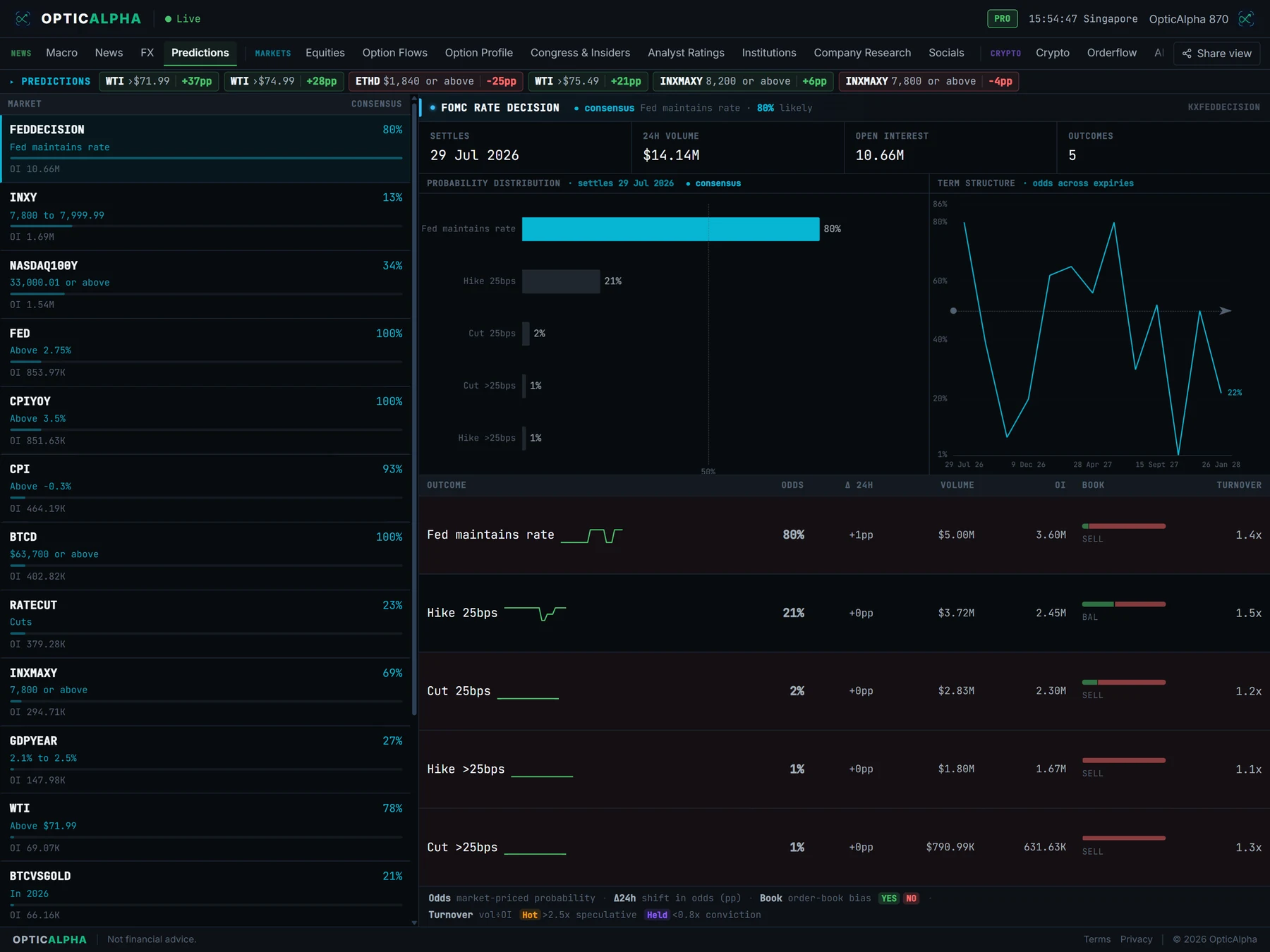
How traders use this
Read implied probability as the market's own consensus forecast, not any single analyst's opinion. A contract priced at 62% isn't one strategist's call, it's the aggregate of every trader willing to put money behind that outcome, weighed against everyone on the other side. That doesn't make it right, but it does make it a different kind of signal than a headline or a hot take.
Term structure is the next thing to check. If the leading outcome's odds barely move across expiry dates, the market expects the current view to hold. If they shift meaningfully further out, the market is pricing a change in the picture before it happens, which is often the more useful read than the near-term number on its own.
Order book bias and capital velocity tell you how much to trust a given move. A probability that jumped on heavy volume and a lopsided order book, backed by real size on one side, reflects conviction. The same jump on thin trading and a balanced book can just as easily unwind, since it took very little capital to push the price there in the first place.
Terms on this page
- Implied probability
- The market's collective estimate of an outcome's likelihood, derived directly from a contract's price (a contract trading at 74 cents implies roughly 74% odds).
- Open interest
- The total number of outstanding contracts for a given market, a rough measure of how much capital is committed to that outcome.
- Term structure
- How implied probability for the same underlying event shifts across different expiry dates.
- Book bias
- Which side of a market (yes or no) holds more resting order size, used as a short-term positioning signal.
- Capital velocity
- Volume divided by open interest, a measure of how actively a market is trading relative to its outstanding size.
Questions traders ask
What is Kalshi?
A CFTC-regulated exchange where contracts settle on real-world event outcomes, like whether the Fed cuts rates at its next meeting or where CPI lands for the month. Each contract's price directly reflects the market's implied probability of that outcome.
How does OpticAlpha pick which markets to show?
The top 12 active series by open interest across Kalshi's finance-relevant categories: Fed decisions, inflation prints, jobs data, and similar macro events, re-ranked every 5 minutes so the list tracks whatever's actually being traded.
What does the term structure chart show?
How the market's implied probability for the leading outcome shifts across different expiry dates for the same event, useful for seeing whether the market expects a view to hold or shift over time.
What is "book bias" in the markets table?
A read on which side of a contract, yes or no, has more resting order size, tagged as buy wall, sell wall, balanced, or low liquidity depending on the depth split.
How current is the data?
Markets refresh on a 5-minute poll. Probability, volume, and open interest always populate; order book depth and the 24-hour sparkline can lag briefly if Kalshi's secondary endpoints are slow to respond.
Related reading
See live event odds
14-day free trial. No credit card required.
20+ live channels · $10.50/mo billed annually