Every upgrade, downgrade, and price target as it posts
Consensus ratings and price target changes from the analyst community, normalized into one feed.
14-day free trial · No card required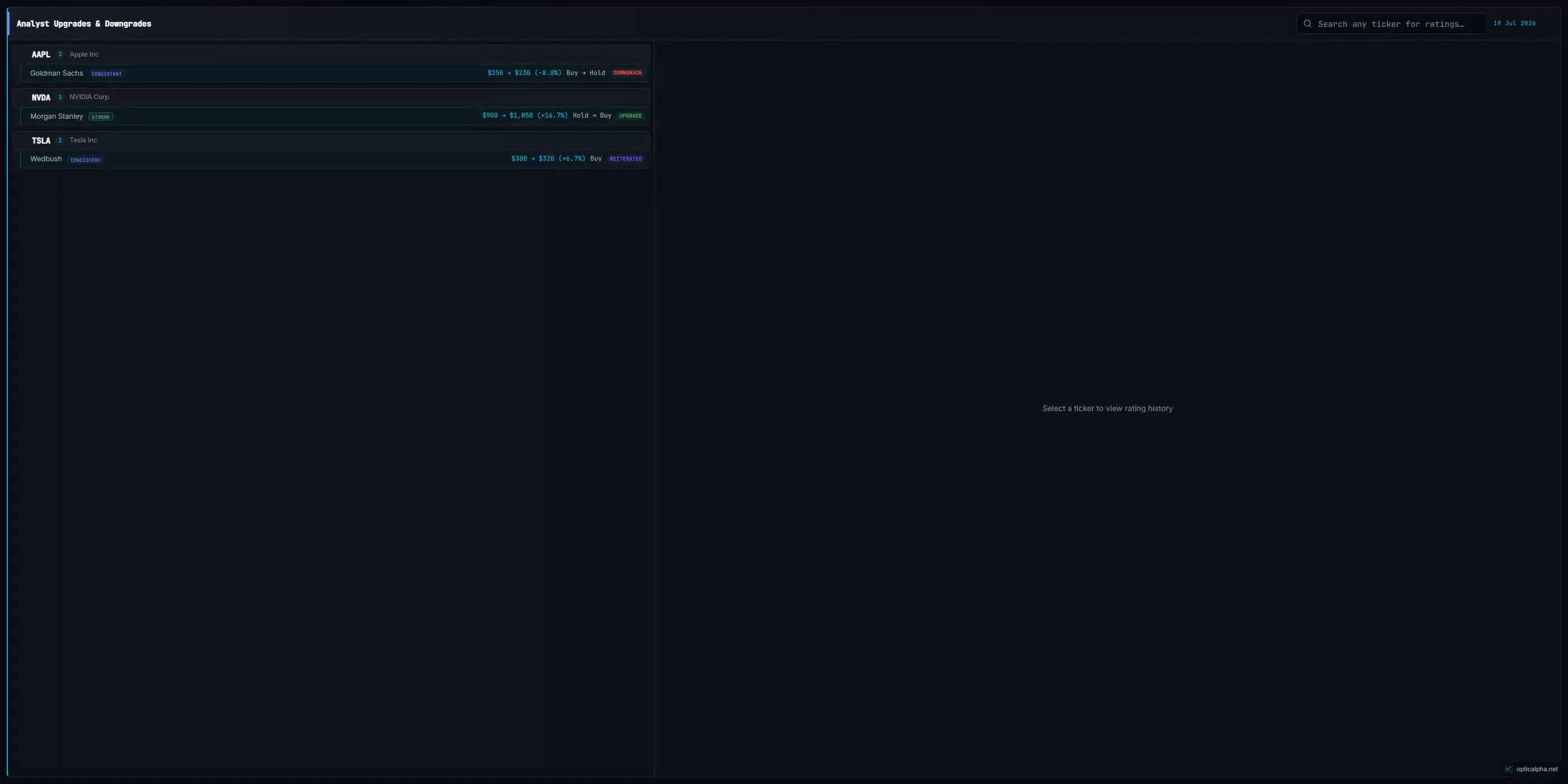 Real terminal UI · illustrative sample data
What is the Analyst Ratings tab?
Every broker on Wall Street grades stocks in its own language. Morgan Stanley says Overweight, Wells Fargo says Buy, and half a dozen others have their own words for roughly the same call. OpticAlpha reads every rating change as it's published and maps it onto one scale: Buy, Overweight, Hold, Underweight, or Sell. The action behind each change gets its own tag too, Initiated, Upgraded, Downgraded, Reiterated, or Price Target Raised, Lowered, or Set, so you know at a glance whether a firm just started covering a name, changed its mind, or simply moved the number without changing the call.
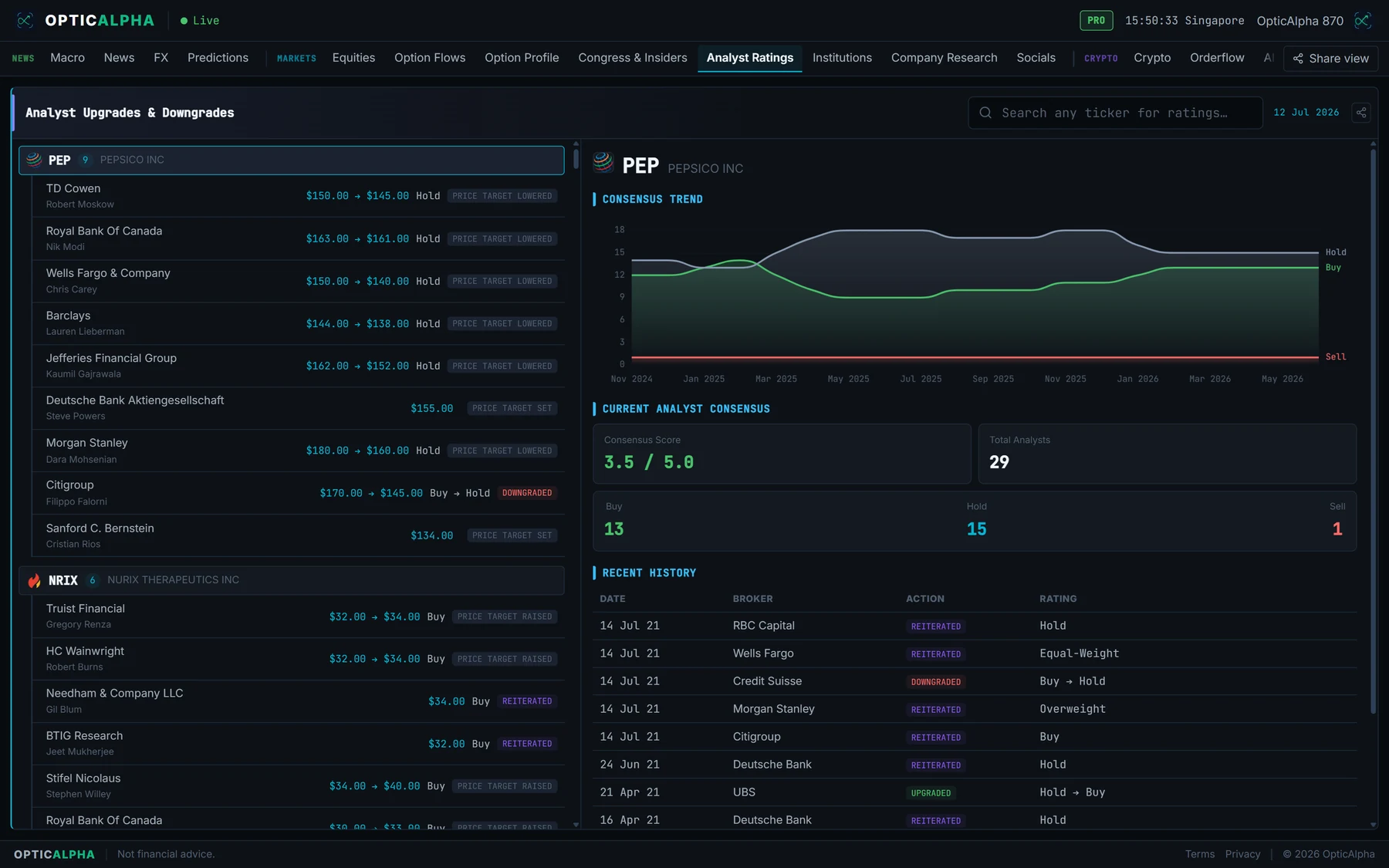
Each row on the feed carries the ticker, the broker, and the analyst's name, along with the old rating and the new one. When the action comes with a price target change, the row shows the old target and the new target side by side, so a downgrade that also cuts the target reads differently from one that leaves it untouched.
Click a ticker and the panel switches to that stock's own record: its current consensus split across Buy, Hold, and Sell, a trend chart of how that mix has moved over time, and its last 50 rating actions in order. The feed itself polls for new filings every four hours through the session, often enough to catch the day's activity without refreshing on every tick.
What OpticAlpha shows
Normalized ratings
Every broker's own language collapses into one scale: Buy, Overweight, Hold, Underweight, Sell. A downgrade from one firm reads the same as a downgrade from any other.
Analyst and price target
Each row names the analyst behind the call, not just the firm, and shows the old and new price target side by side whenever the action includes one.
Per-ticker history
Select a ticker to pull its own consensus trend and its last 50 rating actions, so a single upgrade sits in the context of everything that came before it.
Live feed
The feed polls for new filings every four hours through the session, catching upgrades, downgrades, and target changes as brokers publish them.
Broker credibility score
A rolling 90-day hit-rate grade per broker, reconciled against real price moves after each call and tiered from Strong Track Record down to Limited Data when the sample is too thin to grade. See how it's calculated →
How traders use this
Raw broker language is where most of the confusion starts. One firm's Overweight and another's Buy point at the same idea, but stack them next to each other unlabeled and they don't look equivalent. Normalizing every rating to one five-category scale removes that translation problem, so a trader scanning the feed can compare a call from Barclays against one from Citi without knowing each firm's internal grading quirks.
A single upgrade is one analyst's opinion. A cluster of upgrades from several unrelated firms inside the same week is a different thing entirely, since it usually means multiple independent research desks arrived at a similar conclusion without coordinating. That kind of convergence carries more weight than any one firm's call, and it's the pattern the grouped, per-ticker view is built to surface.
Price target moves without a rating change are easy to miss and worth watching anyway. An analyst who keeps a Hold but raises the target by 20% is telling you something even though the headline rating didn't budge: they're repricing the stock quietly, ahead of a full rating change or instead of one. The feed keeps that old-to-new target on the row specifically so it doesn't get lost next to the more obvious upgrade and downgrade tags.
Terms on this page
- Consensus rating
- The aggregate view across all covering analysts, typically expressed as an average or a distribution across Buy/Hold/Sell.
- Price target
- An analyst's 12-month forecast for where a stock's price will land, distinct from the rating itself.
- Initiated
- A brokerage starting coverage on a stock for the first time, as opposed to changing an existing rating.
- Credibility badge
- A rolling 90-day hit-rate grade per broker, reconciled against real price moves after each rating, tiered from Strong Track Record down to Limited Data when the sample is too small to grade.
- Reiterated
- An analyst keeping their existing rating unchanged, often alongside a price target update.
- Upgrade / downgrade
- A change in an analyst's rating in a more or less bullish direction, respectively.
Questions traders ask
What counts as a rating action?
Five categories: Initiated, Upgraded, Downgraded, Reiterated, and Price Target Raised, Lowered, or Set. Every broker's own wording gets mapped into this same set so the feed reads consistently across firms.
Why normalize ratings instead of showing each broker's original label?
Brokers use different scales, one firm’s "Overweight" is another’s "Buy". Normalizing into five buckets (Buy, Overweight, Hold, Underweight, Sell) means comparing ratings across firms actually means something.
Does the feed show the analyst's name?
Yes, along with the broker, and both the prior and new price target when the action includes one.
How current are the ratings?
The feed updates on a 4-hour poll, pulling fresh rating changes from the source and merging them into the existing history.
Can I see a stock's full rating history, not just the latest change?
Yes. Selecting a ticker pulls its consensus trend and the last 50 rating actions on that name specifically.
Can I tell if a broker's ratings are usually right?
Yes. Each broker carries a Credibility badge, a rolling 90-day hit-rate grade reconciled against real price moves after each call, tiered from Strong Track Record down through Consistent, Mixed, and Below Average. A broker needs a minimum number of resolved calls in that window before OpticAlpha grades it at all, so one with too few recent calls just shows Limited Data rather than a grade built on a noisy sample.
Related reading
See the normalized ratings feed
14-day free trial. No credit card required.
20+ live channels · $10.50/mo billed annually