A full research report, built on demand
Financial health, valuation, peer comparison, and price targets for any ticker, generated in seconds.
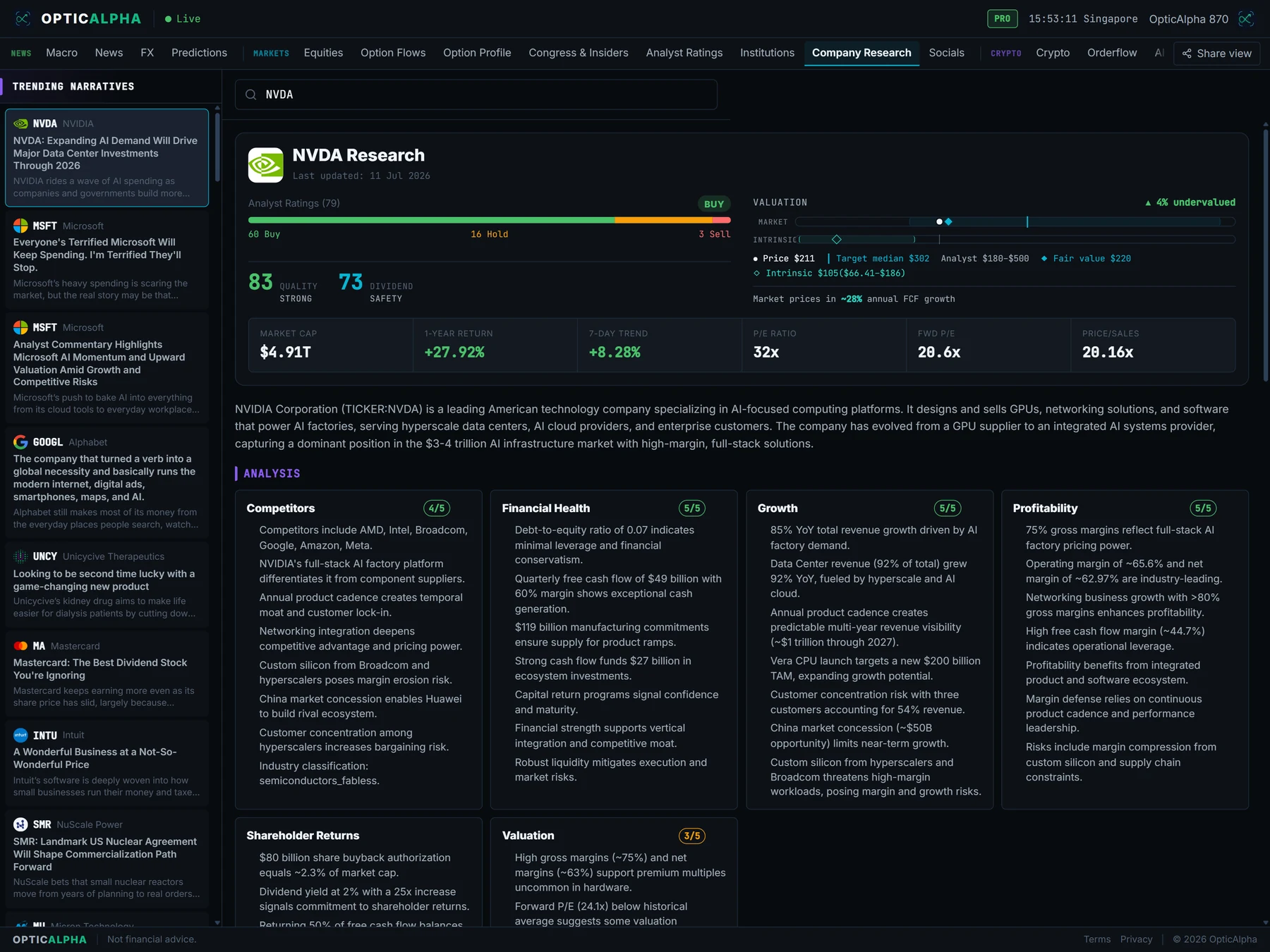
Real terminal UI · illustrative sample data
What is the Company Research tab?
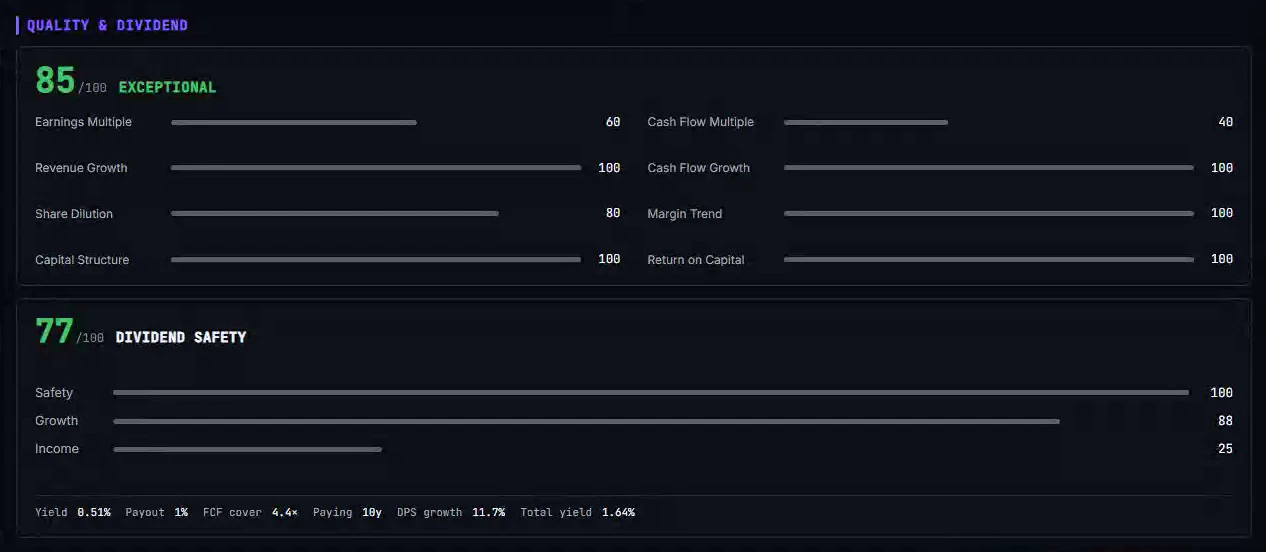
Type a ticker into the Company Research tab and OpticAlpha builds a full research dossier on demand, running its own scoring layer over live company fundamentals: a financial health score from 0 to 100, weighted by sector so a bank and a software company are never judged on the same curve. Alongside the score sit trend charts for revenue, earnings, and debt, each with an analyst forecast band, plus a comparison against similar companies and a consensus of analyst price targets.
The valuation view is built around two numbers shown side by side, rather than picking one. A market-based fair value comes from analyst price targets: what the people who cover the stock professionally think it's worth. An intrinsic fair value comes from a discounted cash flow model: what the business is worth based on its own projected cash flows, independent of what any analyst says. Each one comes with a percentage showing how far the current price sits from it, so you can see at a glance whether the stock trades above or below either estimate.
Underneath both is a set of scored health checks covering things like debt coverage and earnings stability. They're built as progressive disclosure items: a short pass or fail summary up front, with the detail behind each check only a click away, so the page reads like a dossier instead of a spreadsheet dump. Every ticker is cached for 24 hours once it's pulled, so this tab is meant for research between trades, not a continuous stream you leave running.
A dossier, not a data dump
Financial health score
A 0-100 score weighted by sector, so a bank's debt load and a software company's earnings history each get judged against their own industry's norms instead of one generic bar.
Valuation ruler
Two fair value estimates on one scale: a market-based figure from analyst price targets and an intrinsic figure from a DCF model, each with a percentage showing the gap to the current price.
Peer comparison
The same ratios stacked against similar companies, so a metric that looks alarming or reassuring on its own gets checked against what's actually normal for that sector.
Scored health checks
Individual checks on debt, earnings, and cash flow, each scored and collapsed by default. Open the ones relevant to your thesis instead of reading through all of them.
The dossier, in the terminal
Cheap because the market is wrong, or cheap for a reason
A low price alone doesn't tell you why it's low. Pull up the health score next to the valuation ruler and you start to see the difference between a stock that's cheap because the market hasn't caught up yet, and one that's cheap because the underlying business has real problems. A stock trading well under both fair value estimates with a strong health score is a different situation than one trading at the same discount with a score dragged down by weak debt coverage or shrinking margins.
The two fair value numbers are worth checking against each other, not just against the current price. Analyst price targets and a DCF model start from different assumptions: one leans on what professional coverage expects the market to pay, the other on what the business itself is projected to generate in cash. When the two land close together, that's some confirmation. When they diverge, say a stock sitting well above its DCF fair value but still under its analyst-target median, that gap is usually more useful than either number on its own, since it points to exactly where the disagreement sits.
Peer comparison is what keeps both numbers honest. A margin that looks thin in isolation might be normal for the sector, and a debt ratio that looks fine on its own can be high next to direct competitors. Reading the health score, the valuation ruler, and the peer comparison together is closer to how an analyst actually works through a name than staring at any single metric would be.
Terms on this page
- Financial health score
- A composite 0-100 score across profitability, growth, and balance sheet metrics, weighted by sector.
- DCF (discounted cash flow)
- A valuation method that estimates a stock's intrinsic value from projected future cash flows discounted back to the present.
- Peer comparison
- Benchmarking a company’s key ratios, like P/E or revenue growth, against a set of similar companies in the same industry.
- Price target consensus
- The average or median 12-month price forecast across all analysts covering a stock.
- Scorecard
- OpticAlpha's side-by-side comparison of a company's own metrics against its sector average, covering both quality scores and valuation multiples.
Questions traders ask
What loads when I search a ticker?
A financial health score, revenue and earnings trend charts with an analyst forecast band, a peer comparison, price target consensus, and a set of scored health checks, built from live company fundamentals and OpticAlpha's own scoring layer.
What is the fair value shown on the valuation ruler?
Two figures side by side: a market-based fair value from analyst price targets, and an intrinsic fair value from a discounted cash flow model. Seeing both lets you tell whether the stock is cheap relative to what the market expects or relative to its own cash flows.
How is the financial health score calculated?
A composite across eight metrics covering profitability, growth, and balance sheet strength, weighted by sector so a bank isn't scored on the same curve as a software company.
How current is the data?
Each ticker is cached for 24 hours, so a search after that window pulls a fresh set of financials, valuation, and peer data.
What's the difference between this and the Analyst Ratings tab?
Company Research is a deep, single-ticker dashboard covering fundamentals and valuation. Analyst Ratings is a live feed of every rating action across the market, without the fundamentals.
Related reading
Every ticker, one dossier
14-day free trial. No credit card required.
20+ live channels · $10.50/mo billed annually