What Congress is buying and selling
Every disclosed trade by party, chamber, and direction, as it files.
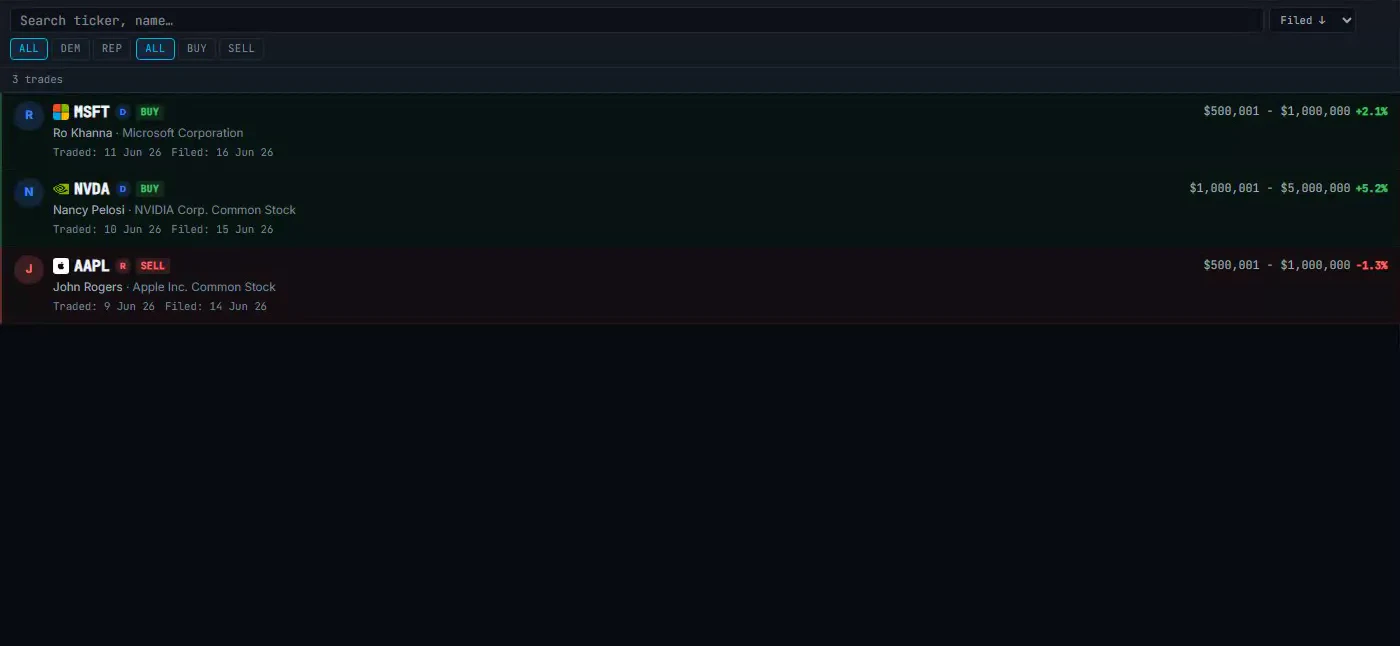 Real terminal UI · illustrative sample data
How congressional trade disclosure works
Members of Congress and senior staff are required to disclose their stock trades under the STOCK Act, a 2012 law that applies to any transaction above $1,000. The filing itself is called a Periodic Transaction Report, or PTR, and it has to be submitted within 45 days of the trade. That 45-day window is a ceiling, not a target: some file within days, others use most of the window.
One detail trips people up the first time they see this data: the dollar amounts are ranges, not exact figures. A PTR reports a value bracket like "$15,001 to $50,000" because that is what the disclosure form itself asks for. OpticAlpha shows the same range the filer reported, not a rounded or averaged estimate.
the transaction date
up to 45 days later
The PTR is filed somewhere inside that window, most often well before the deadline, and the trade shows up on the feed once the filing is processed.
Every disclosed trade, tagged by party and direction
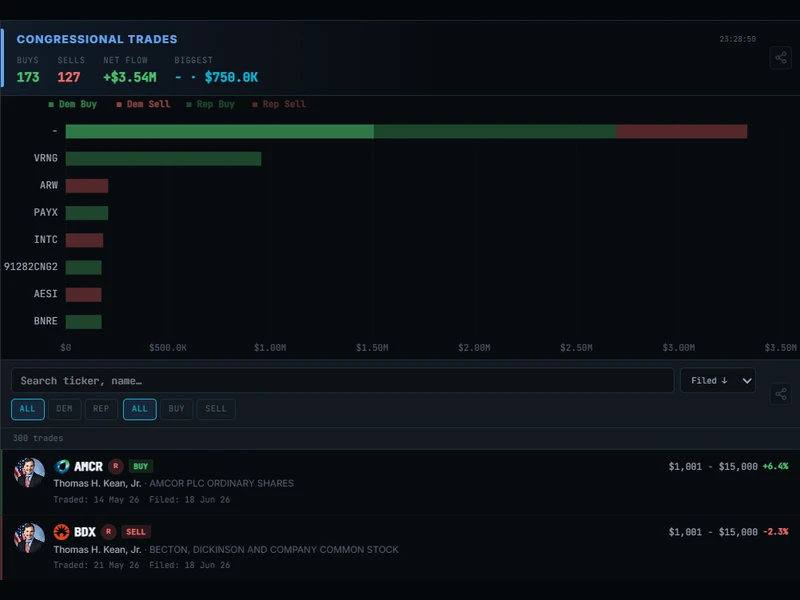
Each row carries the politician's name, party, chamber, ticker, transaction type, the disclosed amount range, and the filing date, colored so you can scan a busy feed without reading every field.
Party-direction color coding
Democrat buying shows in blue, Democrat selling in violet, Republican buying in green, Republican selling in red. This is a party-identity scheme, separate from the green-up, red-down convention used elsewhere in the terminal.
Net buying and selling by party
A summary chart aggregates dollar midpoints by party and direction, so you can see at a glance whether one side of the aisle has been net buying or net selling recently.
Chamber, ticker, and amount range
Every filing keeps its original detail: House or Senate, the exact ticker traded, and the disclosed value bracket exactly as the member reported it.
The feed, as it actually looks
A sector clue, not a trade signal
Congressional trading data is best treated as a sector-positioning clue rather than a direct buy or sell trigger. A cluster of defense-sector buys ahead of a budget vote, or healthcare buys from a member who sits on a relevant committee, can point you toward where attention is building before it shows up in the news. It is context, the kind of thing you'd note alongside flow and price action, not a standalone reason to enter a position.
Keep the color convention in mind while you read the feed. Green here means a Republican buy, not a bullish signal, and blue means a Democrat buy, not a bearish one. It is easy to glance at a green row out of habit and read it the way you'd read a price chart. On this tab, the color is telling you who traded, not which way the market is likely to move.
Terms on this page
- STOCK Act
- The 2012 law requiring members of Congress and senior staff to publicly disclose stock trades above $1,000 within 45 days.
- Periodic Transaction Report (PTR)
- The specific disclosure form used to report an individual trade under the STOCK Act, the source document behind every row in the feed.
- Amount range
- The bracketed dollar value (for example $15,001-$50,000) that disclosure rules require instead of an exact transaction amount.
- Party-direction color coding
- OpticAlpha's color convention on this tab: blue for Democrat buys, violet for Democrat sells, green for Republican buys, red for Republican sells.
- Filing lag
- The gap between when a trade happens and when it becomes public, legally capped at 45 days but often shorter in practice.
Questions traders ask
Are members of Congress required to disclose their stock trades?
Yes. Under the STOCK Act, members of Congress and senior staff must publicly disclose stock transactions above $1,000 within 45 days of the trade, which is where this data originates.
Why are amounts shown as ranges instead of exact dollar figures?
The disclosure forms themselves only require a value range, such as "$15,001 to $50,000," rather than an exact dollar amount. OpticAlpha displays the same ranges reported in the original filing.
What does the color coding mean?
Colors track party and direction together: Democrat buying shows in blue, Democrat selling in violet, Republican buying in green, Republican selling in red. This is a party-identity color scheme, not the standard green-up, red-down convention used elsewhere in the terminal.
How current is congressional trading data?
Trades appear on the feed once the disclosure is filed and processed, typically a matter of days after the transaction given the 45-day legal filing window, though many members file sooner.
Is congressional trading data useful for finding trade ideas?
It is best used as a sector-positioning clue rather than a direct signal, for example a cluster of defense-sector buys ahead of a budget vote, or healthcare buys ahead of a policy decision a committee member would have visibility into.
Related reading
Every disclosed trade, as it files
14-day free trial. No credit card required.
20+ live channels · $10.50/mo billed annually