Insider buys and sells, straight from EDGAR
Open-market Form 4 filings over $100K, no third-party delay.
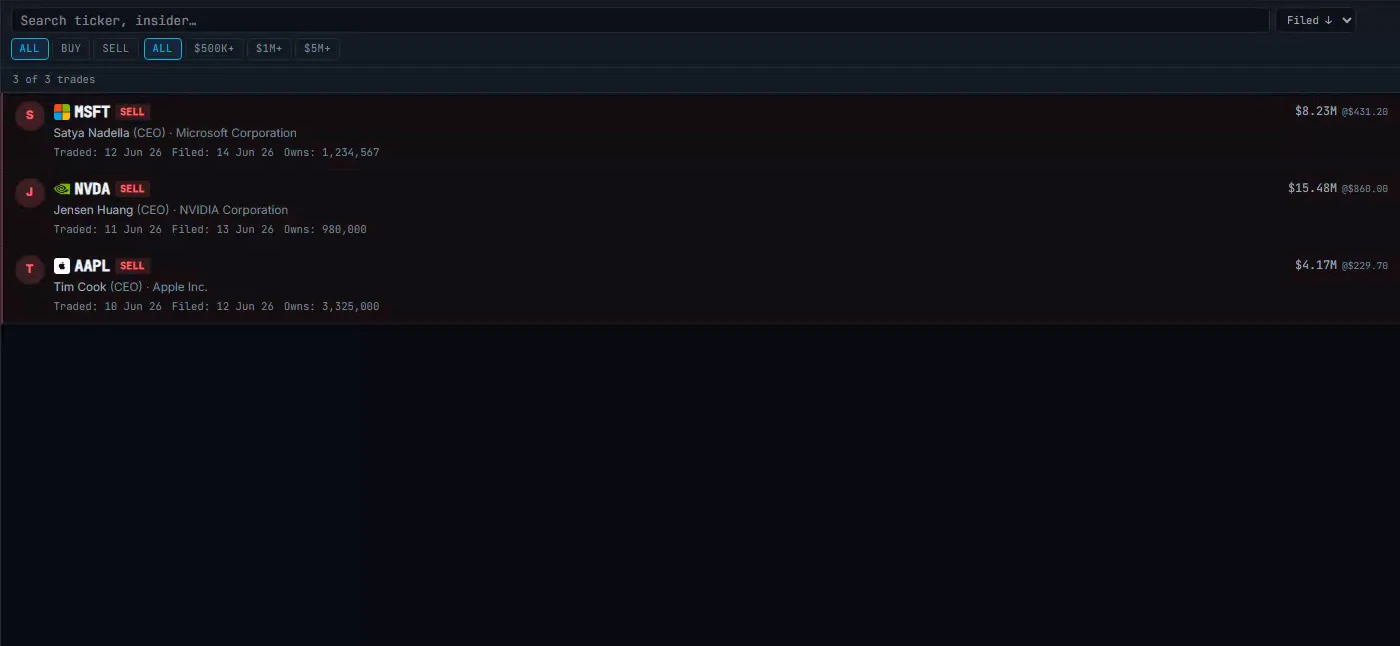 Real terminal UI · illustrative sample data
What is a Form 4 filing?
A Form 4 is the disclosure that company officers, directors, and anyone holding more than 10% of a company's shares must file with the SEC every time they buy or sell their own company's stock. The filing window is tight: two business days from the trade date, not the end of the month or the end of the quarter. That speed is what makes Form 4 data useful in a way 13F holdings are not. It shows up almost as fast as the trade itself.
Two transaction codes matter for reading intent. Code P is an open-market purchase, meaning the insider paid cash for shares the same way any other investor would place an order. Code S is an open-market sale. Both differ from a stock grant or an option exercise, where the insider did not choose to put new money in or pull cash out at a market price of their own choosing.
The people required to file are officers, directors, and beneficial owners above the 10% threshold. All three groups have access to information the rest of the market does not, which is exactly why the disclosure requirement exists in the first place.
What OpticAlpha shows
OpticAlpha filters SEC EDGAR down to the filings that actually matter for trading, before the feed ever reaches your screen.
Open-market only
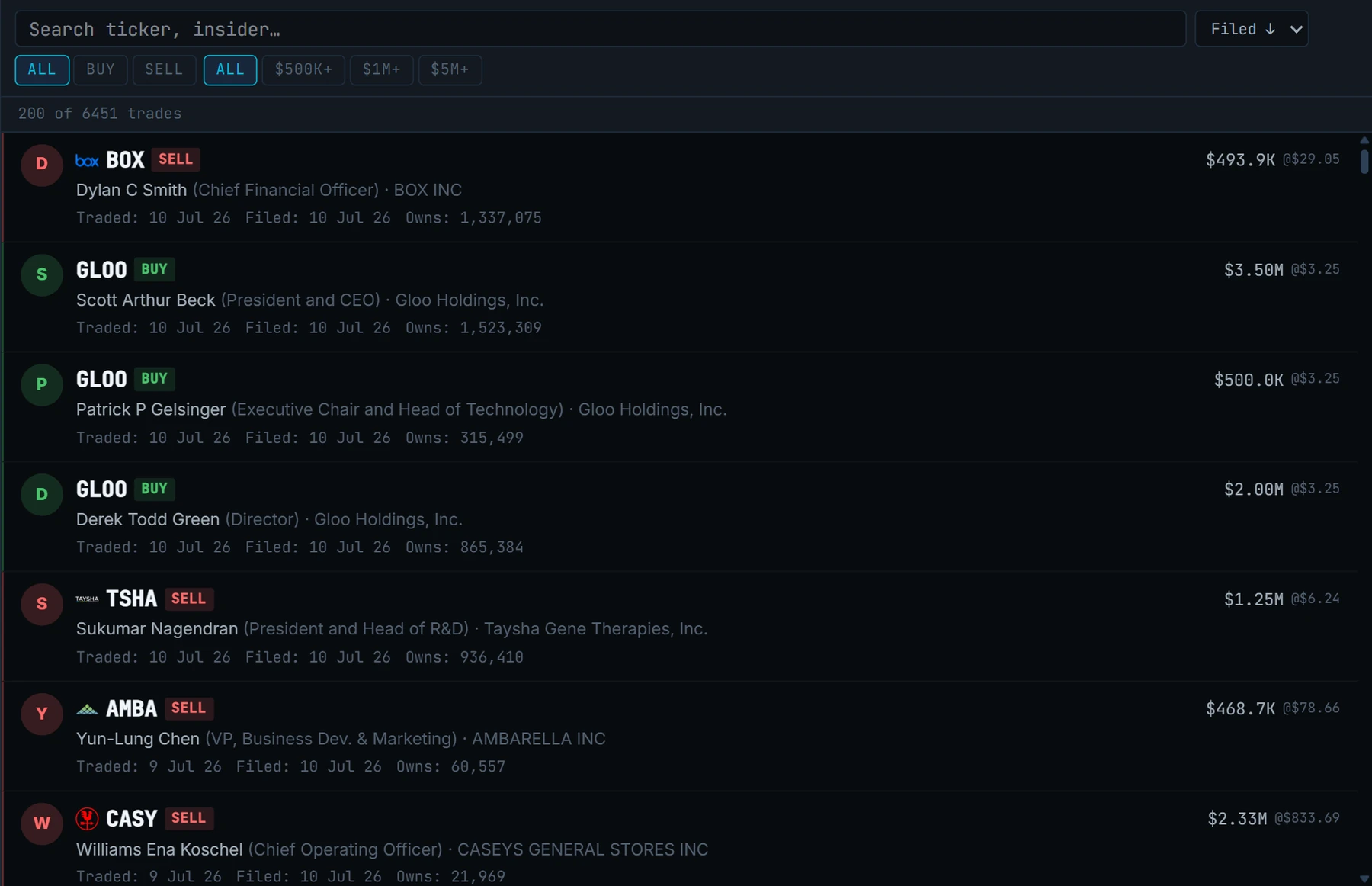
Only code P and code S transactions make the feed. Grants, option exercises, and other non-market codes are filtered out before you ever see them.
$100K+ threshold
Small transactions, like shares sold to cover a tax bill on routine vesting, get filtered out. What's left is large enough to represent a real, considered decision by the insider.
30-day rolling window
The feed holds a rolling 30 days of qualifying filings, so you can scan recent activity across tickers without running EDGAR's full-text search yourself.
Built-in filters
Narrow by Type (buy or sell), Min Value ($500K, $1M, $5M), Sort (newest filed or largest value), or Search by ticker, insider name, or title.
See it live
How traders use this
Not every insider trade is worth a second look. A large open-market buy from a CFO or CEO who is not on a pre-scheduled 10b5-1 plan is one of the higher-quality signals available in public markets, because that person is risking their own money with full knowledge of how the business is actually doing. The threshold most traders watch for is $1M and up. Below that, a purchase can easily be a rounding error against someone's net worth rather than a real conviction bet.
Sells are noisier. Executives sell for reasons that have nothing to do with a stock's outlook: a house down payment, a tax bill, a divorce settlement. A sale under a 10b5-1 plan, set up months in advance on a fixed schedule, carries almost no signal at all. The filing itself will not tell you which is which, but a cluster of discretionary sells across multiple insiders at the same company in a short window deserves more attention than any single sale.
Provenance matters too. OpticAlpha reads Form 4 filings directly from SEC EDGAR, not from a third-party data reseller. Every qualifying filing over $100K lands in the feed, not a curated subset chosen by a vendor, and the only lag between the trade and the row appearing is whatever time SEC's own processing takes. Many trackers add a day or two on top of that.
Terms on this page
- Form 4
- The SEC filing insiders must submit within two business days of a change in their beneficial ownership, including open-market buys and sells.
- Open-market purchase (code P)
- An insider buying shares on the open market with their own funds, the same way any other investor would place an order.
- Open-market sale (code S)
- An insider selling shares on the open market, distinct from shares surrendered for tax withholding or exercised from options.
- 10b5-1 plan
- A pre-scheduled trading plan insiders set up in advance to sell shares on a fixed schedule, which removes the appearance of trading on nonpublic information. Trades under a 10b5-1 plan carry less signal than a discretionary buy.
- Beneficial owner
- Anyone who owns more than 10% of a company's shares, who is also required to file Form 4 alongside officers and directors.
- SEC EDGAR
- The SEC's public filing system. OpticAlpha reads Form 4 filings directly from EDGAR rather than through a third-party data reseller.
Questions traders ask
What is a Form 4 filing?
A Form 4 is the SEC filing that company officers, directors, and large shareholders must submit within two business days of buying or selling their own company's stock. OpticAlpha shows only open-market purchases and sales, the transaction types most people mean by "insider trading" in the legal, disclosed sense.
Why does OpticAlpha only show trades over $100,000?
Small transactions, like an executive selling shares to cover taxes on a routine vesting event, add noise without much signal. Filtering to $100K and above keeps the feed focused on transactions large enough to represent a real, considered bet by the insider.
Does OpticAlpha include stock grants or option exercises?
No. The feed excludes grants and option exercises and shows only open-market purchases (code P) and sales (code S), where the insider used their own money to buy or received cash to sell, the same as any other market participant.
How is this different from other insider trading trackers?
Most third-party trackers license a curated feed that can lag or sample filings. OpticAlpha pulls directly from SEC EDGAR, so coverage includes all qualifying filings rather than a subset, and the only delay is however long SEC processing itself takes.
Are insider buys a reliable signal?
Large open-market purchases by a CEO or CFO who is not on a pre-scheduled 10b5-1 trading plan are generally viewed as one of the higher-quality signals available, since insiders are risking personal capital with full knowledge of the business. It is one input, not a standalone trade trigger.
Related reading
Every open-market buy and sell, filtered for signal
14-day free trial. No credit card required.
20+ live channels · $10.50/mo billed annually