Read the order book, not just the candle
Live depth of market and cumulative volume delta for BTC and ETH.
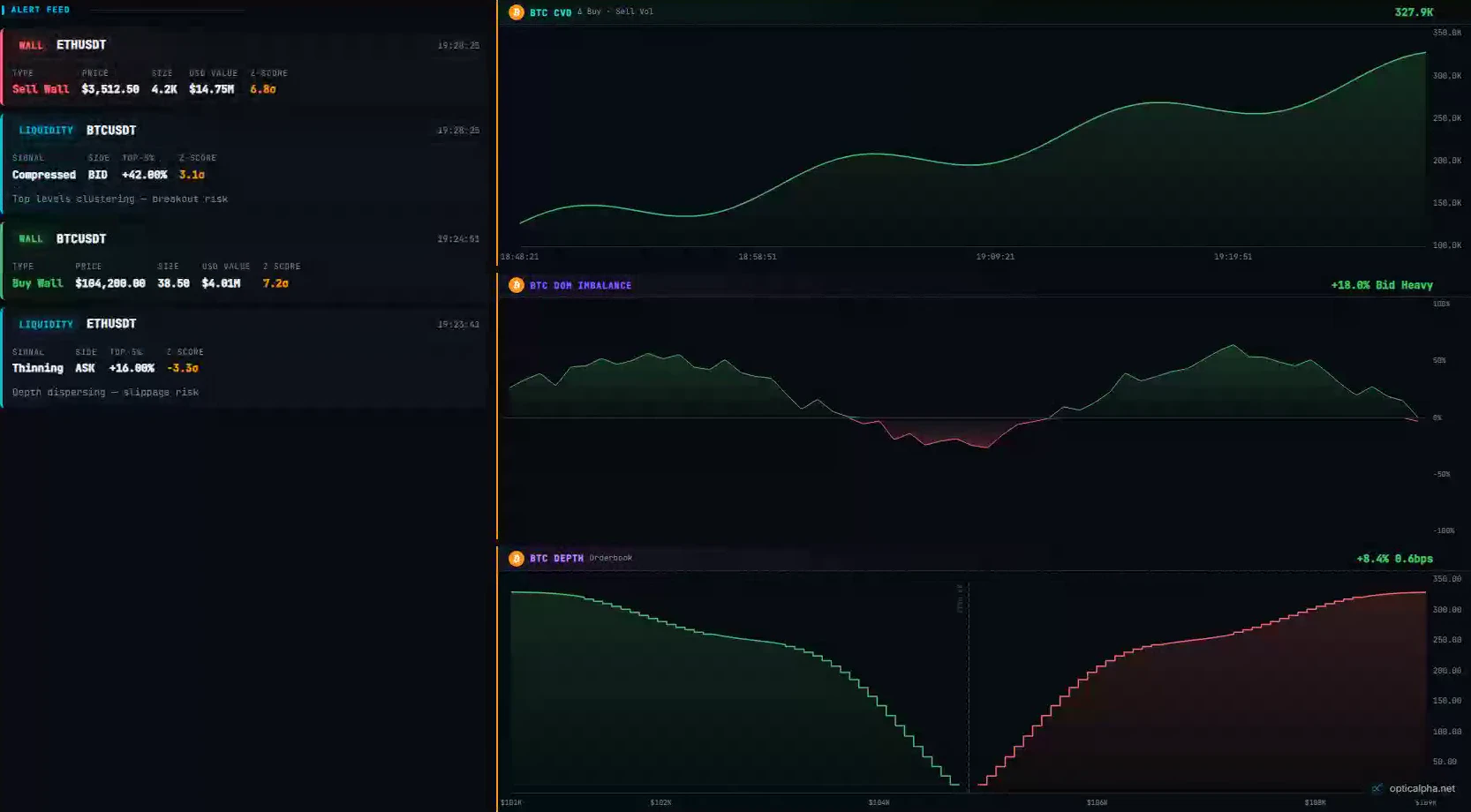
Real terminal UI · illustrative sample data
What is the Crypto Orderflow tab?
Order Book Depth shows a real-time DOM (depth of market) for BTC and ETH. It plots the bid and ask price ladders with the size resting at each level, so instead of just watching the last traded price tick up and down, you can see how much buying or selling interest is actually stacked on either side of it. A ladder that is heavier on the bid side than the ask side is one visual read on order book imbalance.
CVD, or cumulative volume delta, comes from the same live trade data but tells a different story. It is built off the aggregated trade stream, and it is a running total of buy volume minus sell volume. When a market order hits the ask, that counts as buying. When one hits the bid, that counts as selling. Add up the difference over time and you get a line: rising CVD means buyers are the ones paying up to get filled, falling CVD means sellers are the ones hitting bids to get out.
Put together, the two views answer different questions. The order book shows where size is resting right now. CVD shows who has been the aggressor in getting trades done. A price pump with CVD rising alongside it reflects real buying pressure behind the move. A pump with CVD flat or falling is a different story: more often a short squeeze or a thin, low-conviction move that ran on light volume rather than genuine demand.
Depth and delta, side by side
Live order book depth
Bid and ask price ladders for BTC and ETH, with size shown at each level as resting orders arrive and clear.
Cumulative volume delta
A running buy-minus-sell total built from the aggregated trade stream, plotted as one line so you can see buy or sell pressure build in real time.
CVD divergence
Compare CVD against price on the same move. When they agree, the move is confirmed. When they don't, it's a reason to fade it rather than chase it.
Deep, live liquidity
Both the depth ladder and the CVD line read off the live order book and aggregated trade feed, the deepest liquidity available for BTC and ETH.
What the tab actually looks like
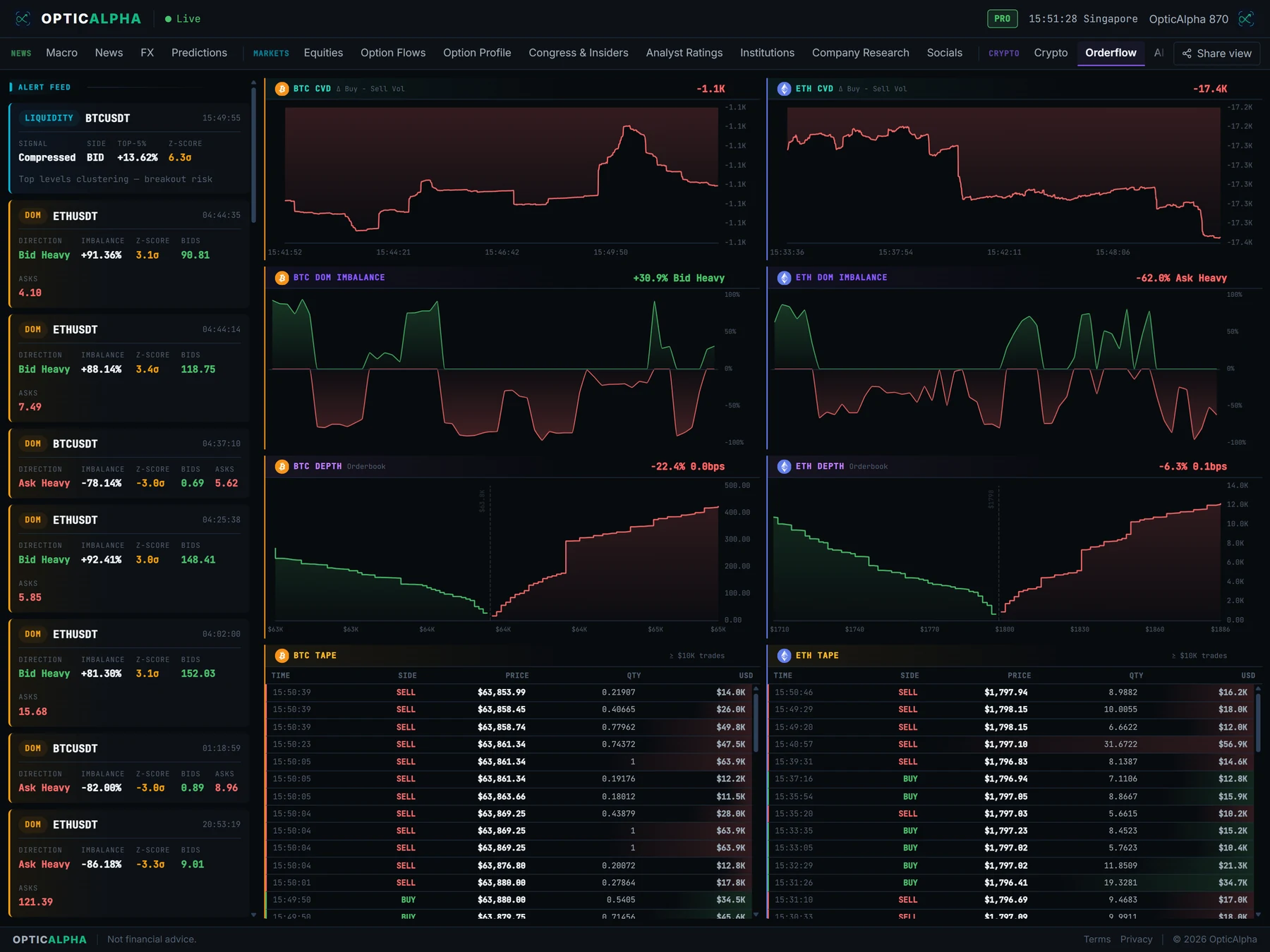
Confirm the move, or fade it
CVD divergence is the main signal traders pull from this tab. Price making a new high looks bullish on its own, but if CVD isn't making a new high alongside it, the buying behind that move is thinner than the chart suggests. That combination, a fresh price high on unconfirmed CVD, is usually read as a move running out of real demand rather than one worth chasing. It doesn't call the exact top, but it flags that the move is more fragile than it looks.
The order book gets used differently, more for the next few minutes than the next few hours. A scalper watching the DOM is looking for resting size, a wall of bids or asks well above the size sitting around it, because that size can act as short-term support or resistance right up until it gets absorbed. Price grinding into a large ask wall and stalling tells you something different than price punching straight through it. Once a wall clears, the level it was defending often stops mattering.
Used together, the two views cover different timeframes of the same question: is this move backed by real size, or not. The order book answers that for the next few ticks. CVD answers it for the move as a whole.
Terms on this page
- Cumulative Volume Delta (CVD)
- A running total of buy volume minus sell volume, used to gauge whether a price move is backed by real aggressive buying or selling.
- Order book depth
- The live list of resting buy and sell orders at each price level, also called the DOM.
- CVD divergence
- A situation where price moves in one direction while CVD fails to confirm it, often read as a sign the move lacks real conviction.
- Aggressor
- The side of a trade that crosses the spread with a market order, as opposed to the passive side sitting in the book.
- Book imbalance
- A skew in resting size between the bid and ask sides of the order book, sometimes used as a short-term directional signal.
Questions traders ask
What is cumulative volume delta (CVD)?
A running total of buy volume minus sell volume, built from the live aggregated trade stream. Rising CVD means market orders are hitting the ask more than the bid, meaning buyers are the aggressor.
Why does a price move with flat or falling CVD matter?
It's a divergence signal. If price prints a new high but CVD doesn't confirm it with fresh buying, the move is more likely to be thin, a short squeeze, or otherwise low-conviction, rather than backed by real demand.
What is depth of market (DOM)?
The live order book, bid and ask ladders showing how much size sits at each price level. A wall of size at one level can act as support or resistance until it gets absorbed or pulled.
Which coins does the orderflow tab cover?
BTC and ETH, the two with deep enough order book and trade data to make CVD and DOM readings meaningful.
How is this different from the main Crypto tab?
The Crypto tab covers price, liquidations, and whale activity. Orderflow is specifically about what's happening inside the order book right now: who's aggressing, and where size is resting.
Related reading
Watch the book, not just the price
14-day free trial. No credit card required.
20+ live channels · $10.50/mo billed annually