Headlines, the economic calendar, and Fed odds, before the bell
Market headlines, this week's economic events, and FOMC rate probabilities in one feed.
14-day free trial · No card required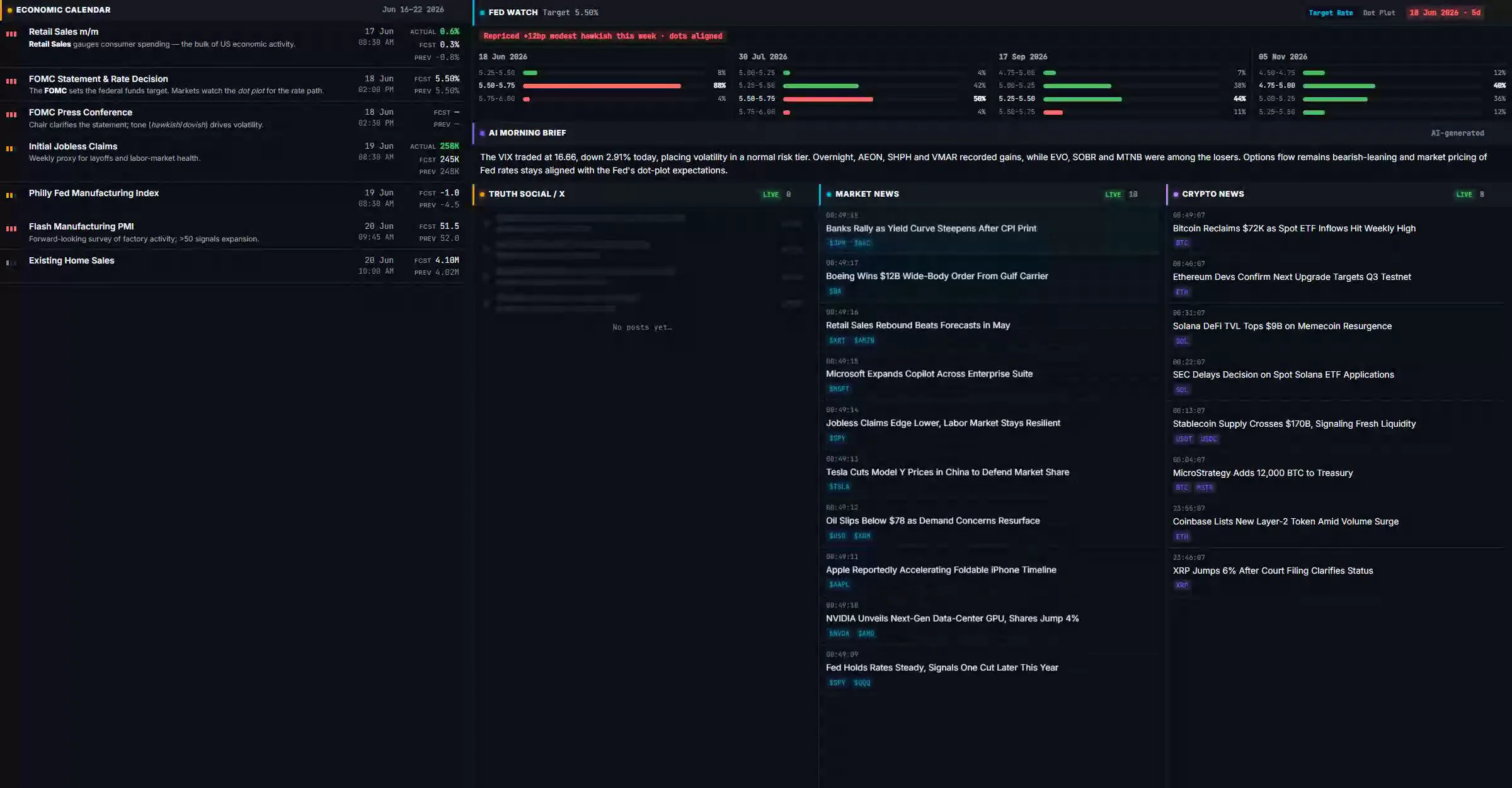 Real terminal UI · illustrative sample data
What is the News tab?
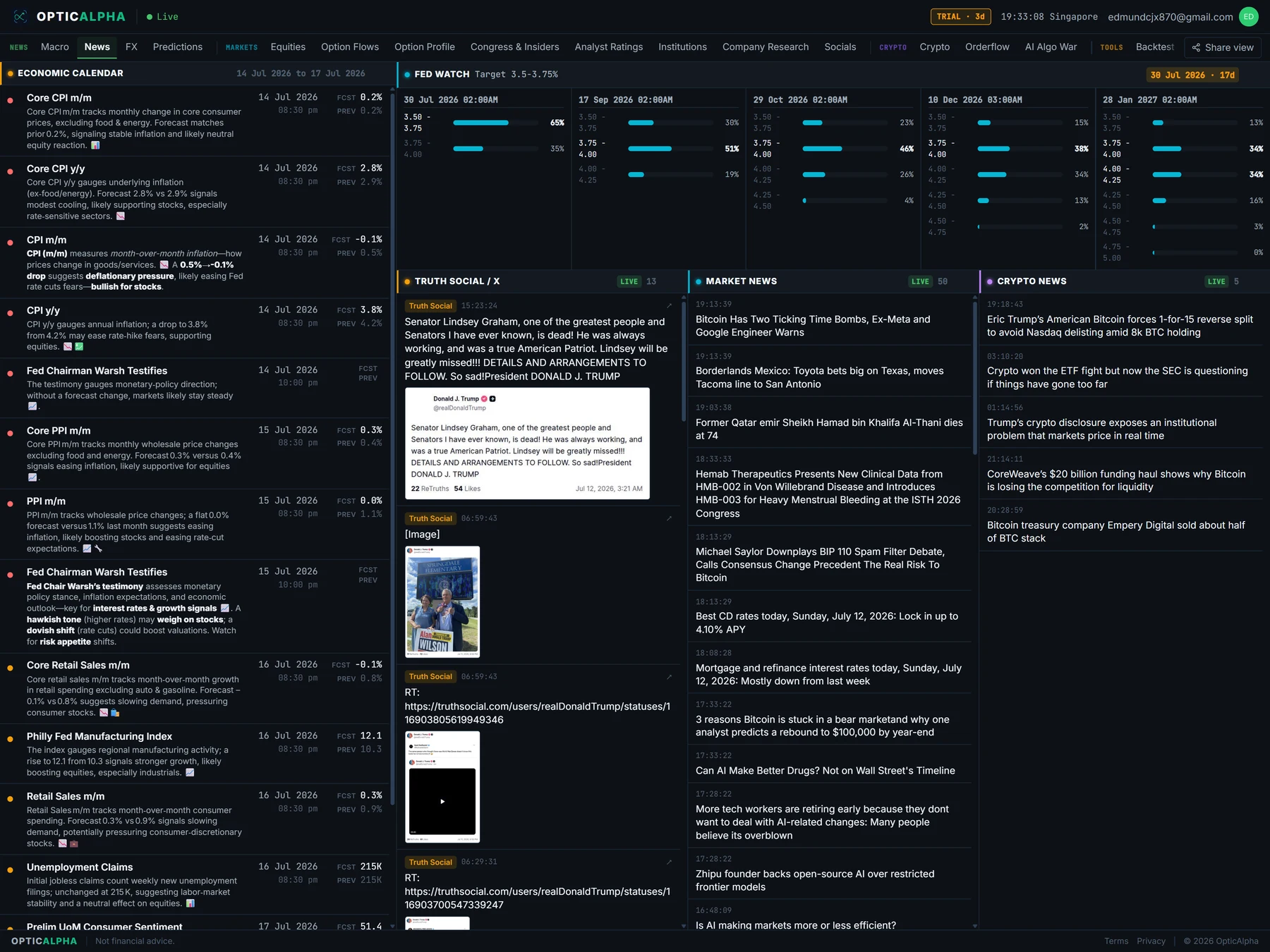
The News tab pulls three separate things into one feed. Market Headlines streams financial news as it publishes, showing the headline, the source, and a timestamp. There is no full article text pulled in, just enough to tell you what happened and when it hit.
The Economic Calendar sits next to it, scoped to USD events for the current week. Each row shows the event name alongside its actual, forecast, and prior values, plus an impact rating of high, medium, or low. The data runs through an LLM processing step before it reaches the feed, one that strips out noise and formats every entry the same way so the calendar reads consistently release after release.
FedWatch closes out the tab with a bar chart of FOMC meeting outcome probabilities: the odds the Fed holds rates, cuts by 25 or 50 basis points, or hikes by 25, broken out for each upcoming meeting. It runs on the same underlying fed funds futures pricing that CME's own FedWatch tool is built on.
What OpticAlpha shows
Live headlines
Headlines stream in with source and timestamp attached, so you can scan what moved overnight or mid-session without waiting on a summary.
Economic calendar
This week's USD events with actual, forecast, and prior values side by side, plus a high, medium, or low impact rating on each one.
FedWatch probabilities
A bar chart of hold, cut, and hike odds for every upcoming FOMC meeting, built from the same fed funds futures data CME's tool uses.
LLM-cleaned data
Calendar entries run through an LLM step that strips noise and formats the output before it ever reaches the feed.
How traders use this
Most of this tab gets used before the opening bell. The habit is simple: scroll the headline feed first thing and check for anything that moved overnight or during the prior session, then decide whether it changes how a position should be sized once the market opens.
The economic calendar gets checked next, usually before 8:30am ET, since that is when the heaviest US releases land. CPI and nonfarm payrolls are the two traders watch closest: both carry a high impact rating on the calendar, and both are known for producing a sharp, fast move in equities and rates within minutes of the print. Knowing a high-impact release is due at 8:30 changes how a trader sizes a position going in, or whether they wait until after the number prints at all.
FedWatch gets pulled up before trading anything rate-sensitive: financials, homebuilders, utilities, growth stocks priced on a long duration of future earnings. If the chart shows the market pricing in a high probability of a hold at the next meeting and a trader is expecting a surprise cut, that gap is the trade. If the odds already lean heavily toward a cut, a lot of that move may already be priced into the tape.
Terms on this page
- FedWatch
- A tool showing the market-implied probability of each possible outcome at an upcoming Fed meeting, derived from fed funds futures pricing.
- Impact rating
- A calendar event's expected market significance, shown as high, medium, or low.
- Actual vs forecast
- The comparison between a released economic figure and what economists expected beforehand. Large surprises in either direction tend to move markets.
- Basis point
- One hundredth of a percentage point (0.01%), the standard unit for describing interest rate changes.
- FOMC
- The Federal Open Market Committee, the Fed body that sets US interest rate policy at scheduled meetings roughly every six weeks.
Questions traders ask
Where do the headlines come from?
A scrolling feed with source, headline, and timestamp. It's headline and source only, no full article, since the point is speed, not depth.
What does the economic calendar show?
USD-focused events for the current week, each with actual, forecast, and prior values plus an impact rating. The raw data gets processed through an LLM step that strips noise before it reaches the feed.
What is FedWatch measuring?
The probability the market assigns to each possible outcome at the next FOMC meetings: hold, cut 25 or 50 basis points, or hike 25 basis points. It's derived from fed funds futures pricing, the same underlying data as CME's FedWatch tool.
How often does FedWatch update?
Whenever the underlying futures pricing shifts enough to move the odds, refreshed on a scheduled poll.
Is this the same calendar as the Forex tab's calendar?
Same underlying source, different scope. News shows USD-only events. Forex shows all 8 major currencies, since a rate trader needs to see EUR, GBP, and JPY events too, not just US ones.
Related reading
See the wire, the calendar, and FedWatch update live
14-day free trial. No credit card required.
20+ live channels · $10.50/mo billed annually